
From Gaming, To Theatre, And Back – My (Circular) Game Design Journey | Adam Barnard
My journey to game design was a little unusual. Maybe circular’s a better word. If
you’d met me at 12, I’d have told you that when I grew up, I wanted to make games.
Actually I’d probably have told you I was already making games, that me and my
friends were making an interstellar adventure that was going to outsell Space
Quest*, and frankly we might need to quit school and go full-time.
(*A gem of 80s/90s gaming. Worth a google.)
Spoiler: our wildly ambitious sci-fi epic never progressed beyond our excited
imaginings, a little concept art and some rickety coding of the title screen. And
then… well, adolescence hit and my interests changed. I was bitten by a different
bug – drama. I studied English at university, and spent more time in student theatres
than lecture halls.
A decade or so later, my career was writing and directing plays – with occasional
sidelines in journalism, film and audio drama – until one day, I took a call that
changed the course of my life. A research group was being formed, combining
scientists, technologists and artists, exploring new approaches to adolescent mental
health. Was I be interested in joining?

At first I thought the caller had the wrong number. Or the wrong Adam. It took a
stranger on the phone to point out that childhood, mental health and science seemed
to be recurring themes in my work. It sounds ridiculous, but I hadn’t noticed. I love
making work with or for young people because I feel there’s a directness and
honesty to that demographic. I tackle mental health because it’s personally important
to me. I’m drawn to science because – wait, isn’t everyone?
So I said yes, not realising that I was making good on the life plans of my 12-year-old
self. Early on, our technology lead said to me: “We’re both storytellers. We just come
at it from different directions.” We began to explore ideas for narrative-driven games
that could support young people’s mental health.

The scientists in our project were mainly psychologists, and they guided the work
towards the idea that mental health depended on social wellbeing, and particularly,
sense of belonging – feeling part of a group, accepted and connected, supported
and safe. For young people, the crucial group is school peers – the people with
whom fate has determined you’ll share your childhood. If you feel secure in your
connections with your peers, you’re more likely to withstand whatever else life throws
at you as you grow up.
To work on peer relations and class climate meant going beyond single-player
gaming. We wanted to create a collaborative immersive experience that an entire
class could play together in the shared space of the classroom. In our augmented
reality game Lina, players use smartphones or tablets to search for clues following
the disappearance of a fictional classmate; they need to co-operate and collaborate,
swapping and sharing information and artefacts, to solve the mystery. As a designer,
I love feeling that I’m bringing the different parts of my practice together: Lina is a
game, but there are theatrical elements, such as guided roleplay, and a strong
emphasis on storytelling, voice acting, original music, and artwork by the brilliant
Chelmsford-based illustrator Hayley Wells.
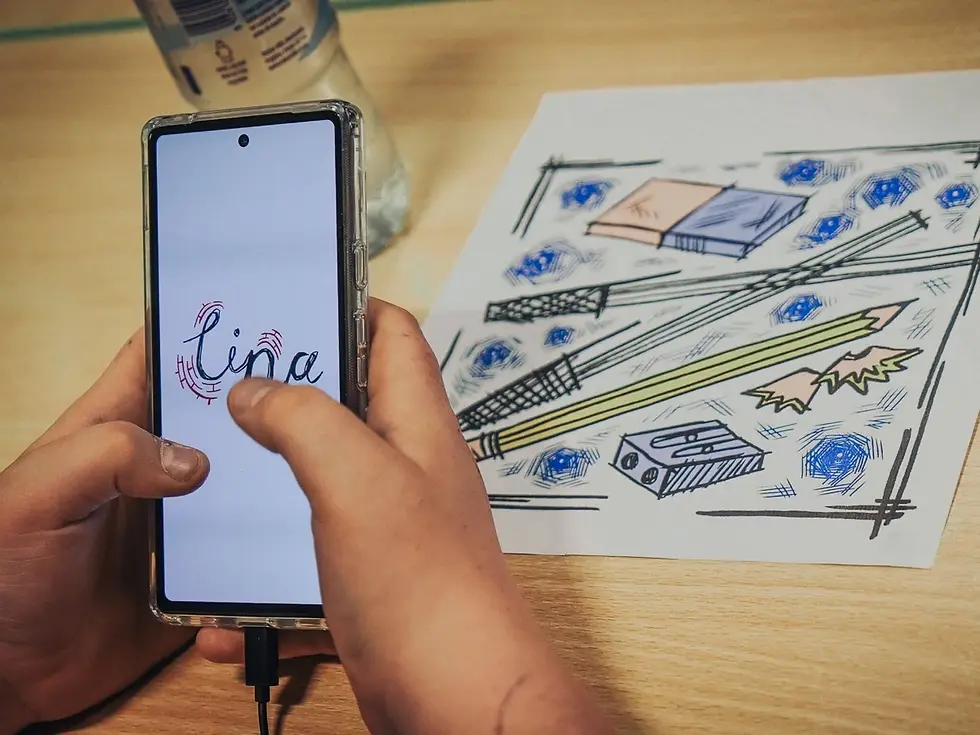
Perhaps our biggest strength is using everyday tech in a new way. We call the format
we’ve created Augmented Social Play (ASP), and hope Lina will be the first of many
ASPs. There might even be an interstellar adventure to make. It’s the destination –
making games – I imagined for myself, even if the journey took me on a pretty wide
orbit.
∘₊✧──────────────────────────────────────✧₊∘
Adam Barnard is non-academic lead of the ASPbelong research group, and co-
designer with Dr Gloria Mittmann of the game Lina. www.aspbelong.com


Comments